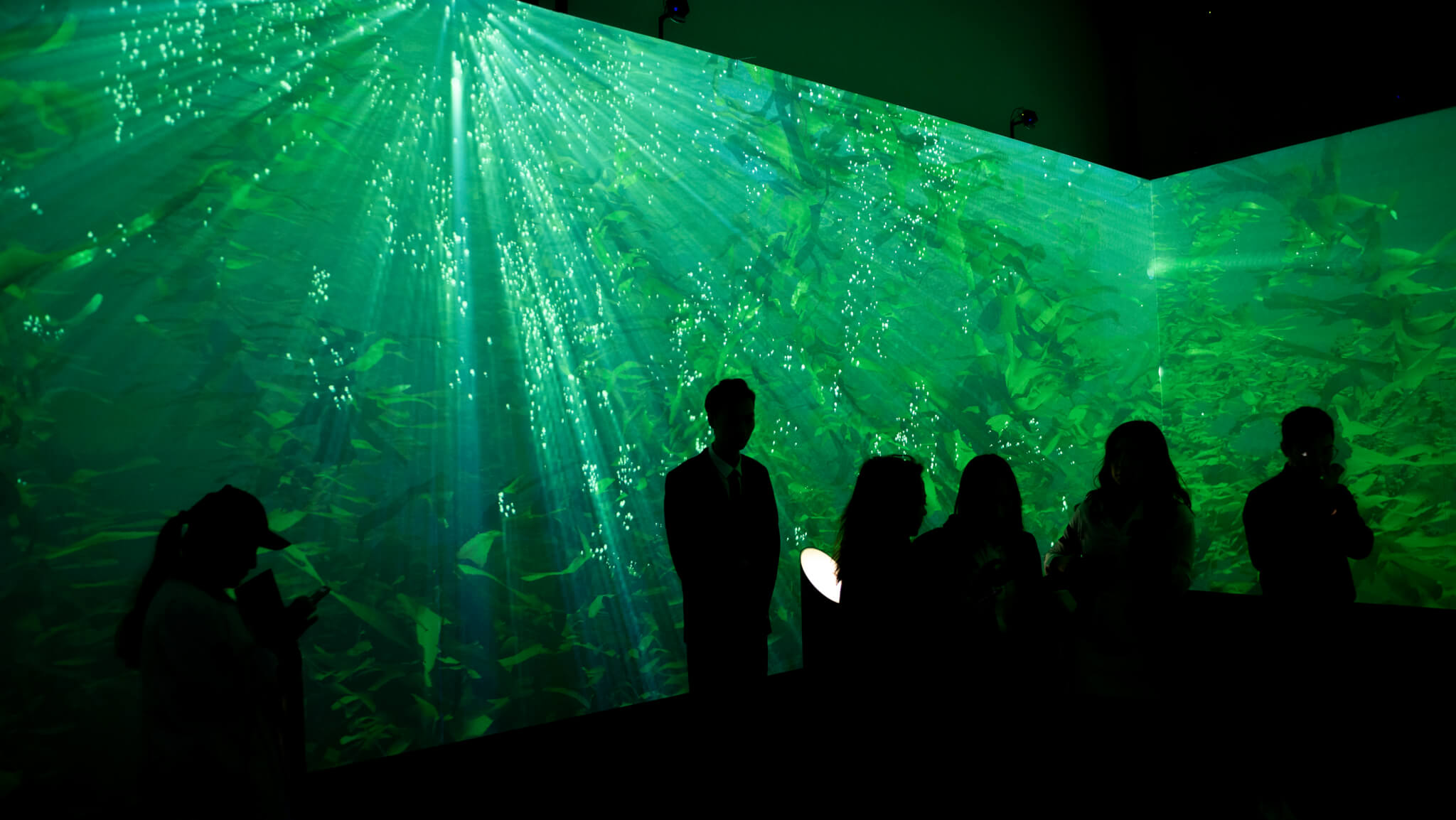
Science Mill’s new kinetic sculpture unravels visible light.
When the Science Mill wanted to commission a new exhibit to occupy one of the former grain mill’s six iconic 40’ silos, the museum faced some challenges. “Our silos are a coveted space,” says Bradley Gray, the Science Mill’s Director of Museum Experience. “We didn’t quite know how to capitalize on the height and use the space to its fullest extent.”
Founder & Board Chair Bonnie Baskin reached out to Brooklyn-based interaction design company Patten Studio, where Creative Director and trained lighting designer Hortense Duthilleux proposed an artwork that turned out to be the perfect fit for the silo.
LIGHT LOOM
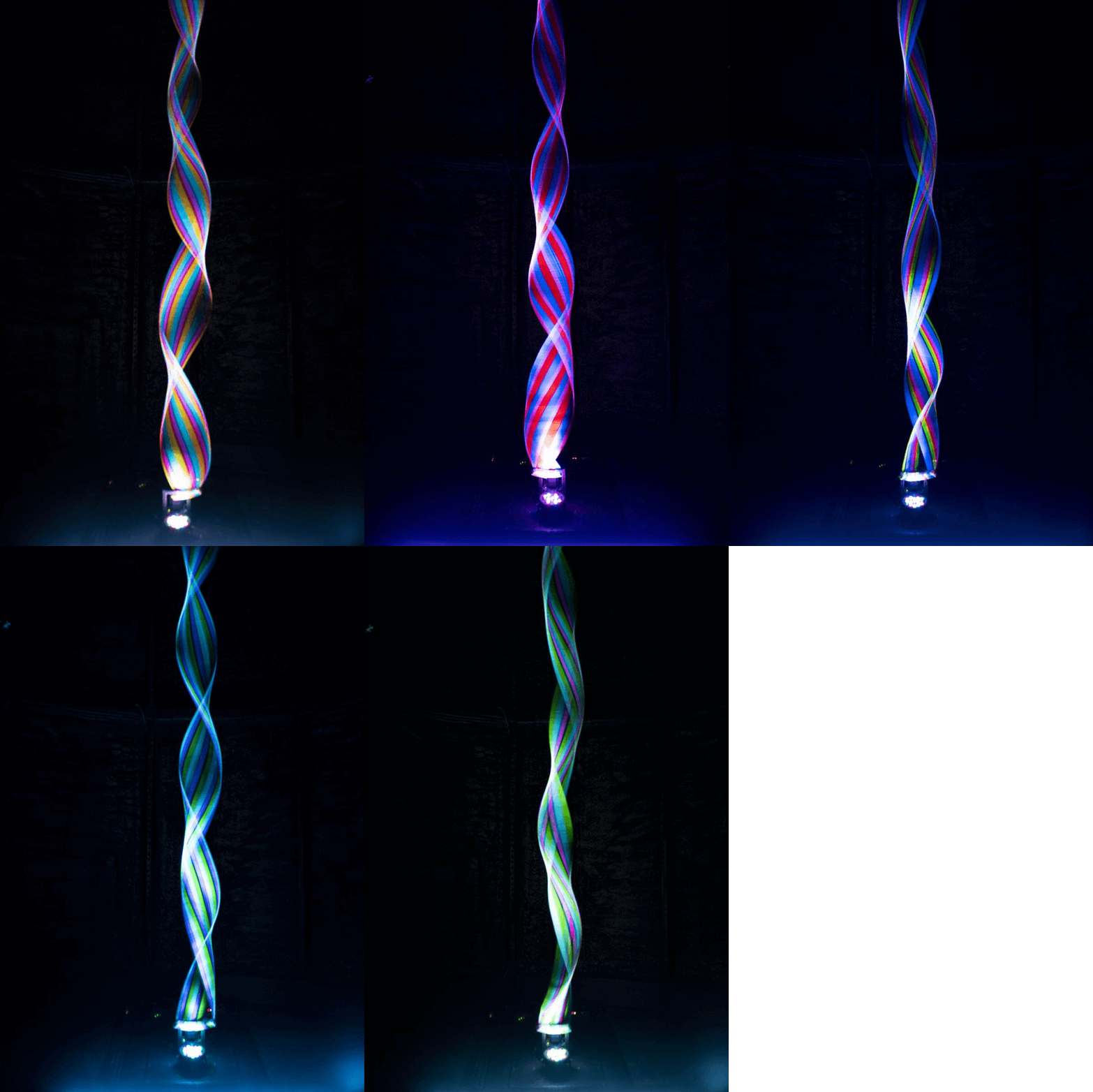
Light Loom is an interactive kinetic sculpture that teaches children about the properties of additive color.
A polyester rope is anchored to the ceiling of a renovated grain silo. A motor at the base churns the rope, forming a physical wave. Red, green, and blue LEDs illuminate the sculpture from below, combining to bathe Light Loom in white light. As the rope passes through the light, a persistence of vision optical illusion splits the white light up into its constitutive colored beams. The primary colors of light: red, green, and blue—but also the secondary colors: cyan, yellow, and magenta—separate out from one another in bands.
The utilization of the silo for this exhibit is phenomenal,” Gray says. “From top to bottom you have color change at a level that I don’t think most folks have really seen before. Watching the light be separated by value is quite the experience, and to see that happen in real time . . . is truly a beautiful blend of art and science.”
YOU PROBABLY DON’T KNOW YOUR PRIMARY COLORS
Light Loom addresses a few misconceptions, or at least conflicts, we have when it comes to how we talk about color. Kids learn to refer to red, yellow, and blue as “primary colors” in art class. While the RYB primary color set is accessible (what’s cyan?) and widely used by artists, it doesn’t stand up to scientific scrutiny when we talk about the physics of light. A more useful primary color set than RYB would be cyan, magenta, and yellow—which can be combined to create a broader range of colors, called a “gamut.”
Subtractive color theory describes the way color behaves when some wavelengths of light are being absorbed and others are being reflected by something physical, such as the pigments in paint or ink; the wavelengths that are being reflected are the ones we perceive, with the ones being absorbed “subtracted” from our perception.
Light Loom demonstrates the properties of additive color, where everything is flipped. Additive color refers to how different wavelengths of pure light behave when they are not being reflected or absorbed by anything. We perceive all of the wavelengths of light being emitted, with nothing “subtracted,” or absorbed. The pixels on a screen or the diodes on an LED billboard use additive color.
INTERACTIVITY
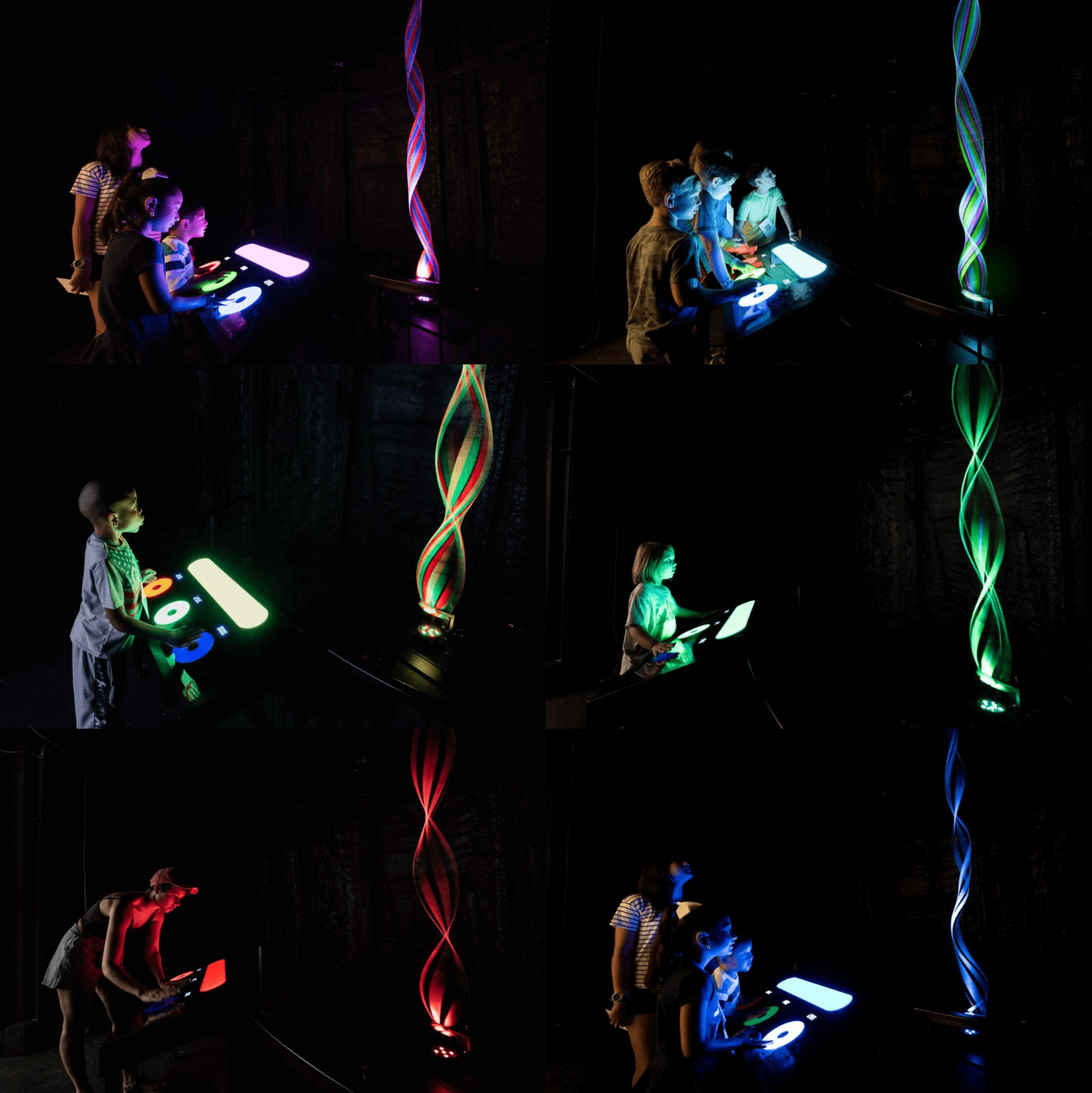
Light Loom is engaged through a touch-free console. By interacting with the different colored optical sensors on the console, visitors dim either red, green, or blue light, forming different additive color combinations. Through play, visitors discover that red and green form yellow, red and blue form magenta, blue and green form cyan, and white light is produced when all three primary colors coincide.
The Science Mill and Patten Studio share a commitment to interactivity. “We want guests to take away a hands-on experience that is memorable and allows guests to have an ‘aha’ moment,” Gray adds. “Light Loom is meeting the interactive mark. It’s also quite innovative. There’s nothing quite like it at the museum.”

AN INTERVIEW WITH LIGHTING DESIGNER HORTENSE DUTHILLEUX
Where did you get the idea for Light Loom?
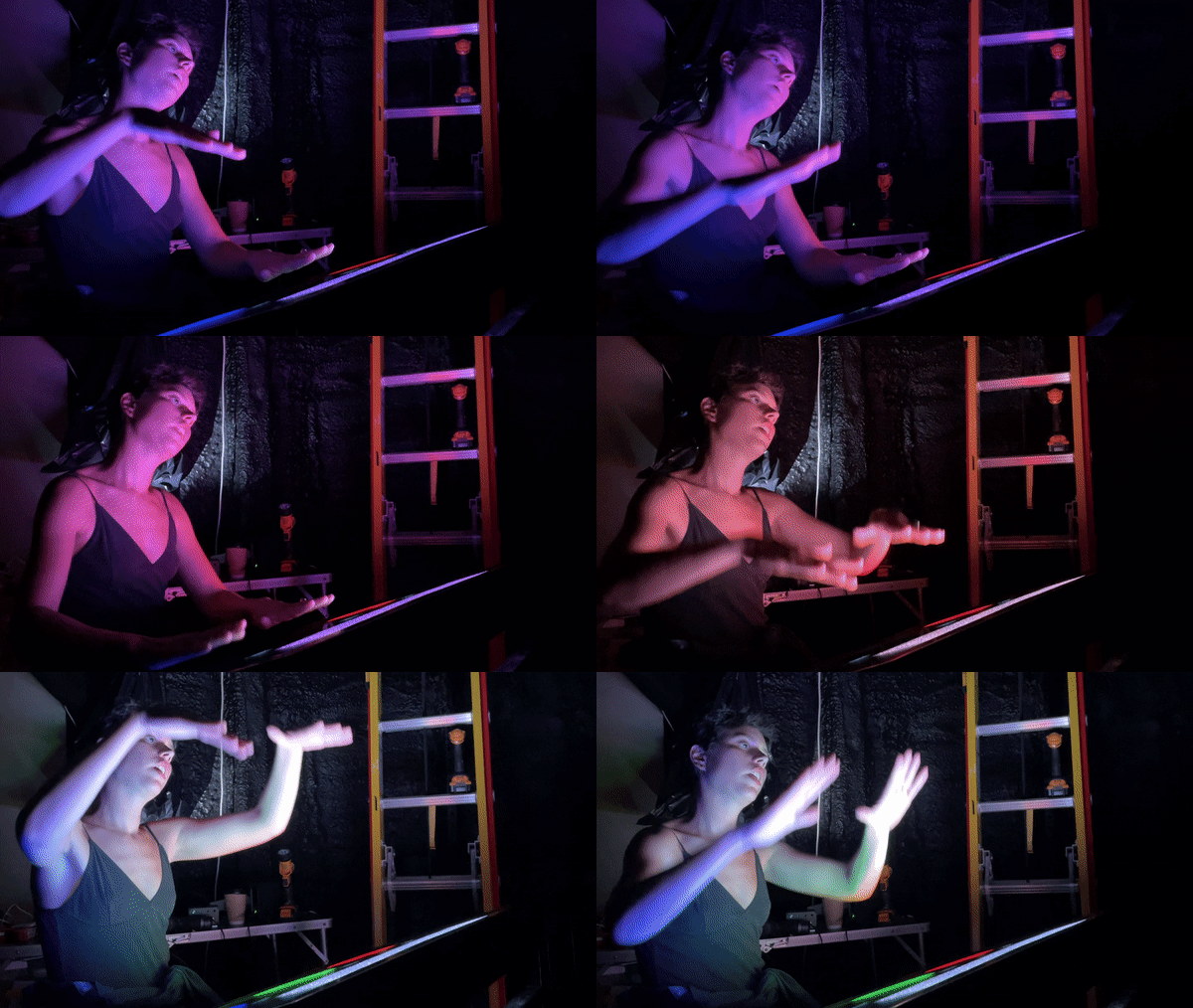
This phenomenon first appeared to me when I was studying for my Masters in London at Central Saint Martins. I was sitting in a lecture, looking at projected content on a screen. I moved my head left to right, and as I moved my head I saw, imprinted on my retina, this RGB band. At the end of the lecture I went over to the projector and waved my hand over the beam of light coming out of it, and I could see again this RGB rainbow following my hand. I was like, what is this? This is amazing!
What is the name of what you had discovered?
The effect I was observing is called persistence of vision. Your retina has memory; so your retina will keep an imprint of an image for a few milliseconds until it disappears. This is how you watch a movie. When you see a movie you perceive still images as continuous; your retina remembers the last image that flashed on the screen. Persistence of vision is why I was able to see that strip of rainbow in my eye while I was sitting in that lecture.
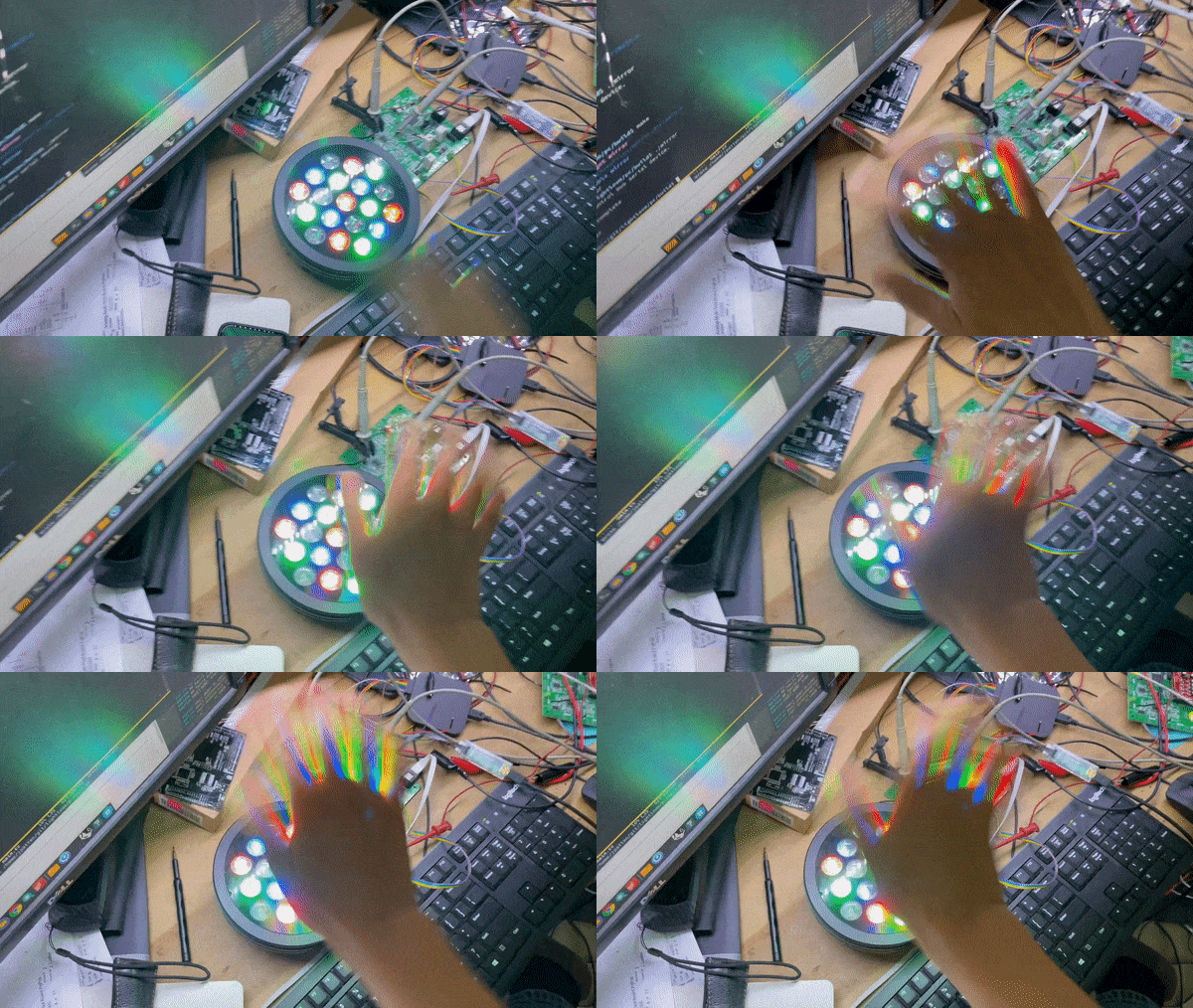
With Light Loom, the movement of the rope creates a much larger volume made up of all the positions the rope has been at while oscillating. The RGB light shining on the sculpture actually flashes these colors sequentially: red, then green, then blue light. But it’s so fast that you can’t see the flashing, and just see the colors mix. The reason why you’re seeing a rainbow is that at Position A the rope was lit up red, in Position B it was lit up green, in Position C it was lit up yellow. Because your eye remembers all of these positions, you end up seeing a rainbow vortex.
Tell us about the first project you worked on with persistence of vision.
I ended up making this giant acrylic propeller and shining a projector light underneath it. The propeller was 10 kilograms, or 20 pounds, 1 meter in diameter, and it was spinning at a hundred kilometers an hour.
The technician and my professor didn’t want me to make it. They were not confident that I could engineer and lathe my own pieces, and make my own connection, and program my own motor—which is fair, because at first I tried to use a washing machine motor, which is also called a suicide motor because if you run it without all the gear that normally goes in the washing machine it’ll just keep spinning at top speed until it explodes. I ended up using one of those motors you use for a lathe machine. Basically people were worried that I was going to chop off heads at the degree show. (No heads got chopped off.) They were trying to encourage me to make it out of foam, which wasn’t working. I had to jump through many hoops.
People were definitely fascinated by the effect. It was this sort of scary but also mesmerizing thing. People wanted to approach it, but not get too close.
How did you get interested in lighting design?
I did textile design for my BA in Paris, and then went to London to study in a program that’s now called “Material Futures” at Central Saint Martins. The basis of the course was speculative design. When I was doing textile design in Paris I was fascinated by colors. We had a physics teacher who was teaching us about dyes and pigment and the chemistry of them, and we had this one class where we talked about light and the interaction of light with how we perceive color. Basically my revelation was when he explained to us the additive property of light, where if you lit up a color that is yellow in blue light, the yellow looks black because yellow is made of red and green light, and if the yellow does not receive that red and green light, it cannot look yellow; it’ll look dark. So that was how I got interested in this. I did a piece with one pattern that looked static in daylight, but when you lit it with different colors of light, like blue or red or green, and you shifted through those different colors of light, the pattern became dynamic and looked animated. Each different color of light would reveal a new pattern.
What challenges did you face working on Light Loom?
It’s really hard to convince people what you can do with light without showing them. With light you need to see to believe. Getting the first proof of concept test was very important. One of the main challenges was to get the effect to work with a light fixture instead of a projector. The light fixture that we ended up using from Color Kinetics is the same light fixture that is used to light the crown of the Empire State Building. But we basically needed to flash the light extremely fast, to the point where it is not visible to the naked eye, the way a projector does. That required a whole control system that is not available on the market, and that we had to create from scratch.
We were able to use three custom printed circuit boards Patten Studio has developed as a part of a technology suite we call “Exponent” for “experiential components.” Basically we had to break that spotlight and rebuild it with our own driver in it. We used our custom Analog Multi-Tool to drive the light, our Motor Controller to run the arm that churns the rope, and our Brooklyn Bridge Board drives in the sensors and LEDs in the RGB console.